Showing posts with label fail. Show all posts

Thursday, 8 January 2015

Boo hoo to the saggy dressed skinny doll

I have just finished sewing the little boy doll from the pattern Simplicity K1900 which my sister-in-law kindly gave to me, and I have a LOT to say about it.


Firstly, big thank-yous to my S.I.L who was very kind to give me the pattern, and I can say with conviction that the pattern picture on the front of the envelope is very cute.  I hope you won't be cross with what I have to say about the pattern itself!

I decided to make boy doll.  I had lots of fun picking out fabrics and cutting him out and embroidering his face.  It was all fun and games until it came to turning the limbs inside out, and then it was HILARIOUS.  I followed their suggested 1/4" seam allowances, and I even made them scant 1/4", but still it was almost impossible to turn the skinny arms out through the minuscule wrists.  The pattern piece suggests the wrists are 7mm across when sewn, giving a circumference of 14mm after stuffing, which means they have a diameter of under 4.5mm.  Do you see the madness here?


Finally I prevailed without torn fabric, and it was time to stuff them.  Har-de-har.  I could just about ram a 4mm knitting needle down the arms (see above comment on the puny diameter), so I managed to use a combination of the knitting needle, tiny bits of stuffing and a kitchen funnel inserted in the arm end to cram stuffing into the hands, arms and legs.  It took me an entire evening to stuff the little blighters for a single doll.

The rest of the doll body went together easily, and although he looks a bit malnourished, I proceeded onto the clothes with hope in my heart.

I made the shirt first.  Here I discovered that they'd omitted to tell me in the cutting directions that the neck facing was needed for view D (the boy) as well as for the girls.  So out came all the fabrics to cut the extra piece.  They give no directions for seam finishes, which is fine if the doll is to sit on your shelf, but less fine if you expect it to withstand the attentions of a lively 2-year-old.  I elected to zig-zag the seams I could.

I then made the little dungaree shorts.  Very cute on the photo.  However, when it came to dress my doll, he does not look like the picture.  Sad times.  The shirt is definitely more roomy than the envelope image shows (especially around the arms) and doesn't quite come down low enough to be sure that the doll doesn't feel draughty around the tummy if he moves.  It requires careful tucking to ensure he's covered below his shorts waistline.  In addition, the shorts are pretty roomy around the hips.  I know that I followed the seam allowances correctly on the shorts because my notches all lined up to the bib part perfectly when I came to attach it, so we can discount incorrect construction on my part.  I can only assume they've cunningly pinned the excess behind the doll before the photo, or else they made the model to a better fitting pattern than the one supplied in the envelope.  That's a bit of a shame.

I had no more luck with the felt shoes.  I sewed them as directed, and this resulted in giant moon-boots that fell off his feet.  I took in an extra 3/8" at the front and re-cut the piece to correct this.  That's quite a correction to get it to look like the photo on the envelope, I'd say.


The hat is also a sad disaster.  Despite adding an extra line of stay-stitching around the brim to prevent the felt stretching, it does not sit snuggly on the dolls head as per the picture.  It looks like a sad loose bowl of custard plonked on his bonce, and comes much further down than the envelope photo shows.  I fail to see how this can go so wrong for such a simple pattern piece.  I can only assume trickery on the part of the envelope photographer.

I made three shirts, two dungarees, two shoes and a hat for my sad doll, because I'd already cut them out at the start.  I hope toddler likes him, but I won't blame him if he doesn't.


So, in summary, cute pattern envelope, shame about the contents.  Either all the boy doll clothes are wrong, or else they've got the wrong seam allowances on the doll itself.  Also, I have learned that I hate sewing titchy tiny doll clothes with a passion.  I don't think I'll be making another doll in a hurry.

Wednesday, 7 January 2015

Notes on designing curtains with rings

This is a post where I point out things to future Alice which should have been obvious to past Alice when she bought curtain fabric for her spare room.

For context, I am making curtains with 40mm metal eyelets at the top.  I need metal eyelets because I am interlining with blackout fabric, and making a polycotton lining too, plus buckram.  This is quite a thickness to expect shonky plastic rings to withstand.  Therefore, I purchased some badass tools to insert metal eyelets from Hanolex.  It involves the biggest hammer I may ever own.  The break even point in tool investment seems to be when you are making more than one set of eyelet curtains, especially when you take into account the recorded delivery postage in sending your beautifully handmade curtains off to someone else to butcher in the eyelets for you.

I like to use the blackout as an interlining rather than a lining fabric.  When making curtains, one tends not to take the lining all the way to the curtain edge.  I find the blackout fabric to be quite stiff compared to some fashion fabrics used for the front of the curtain, so when using it as a simple lining, you end up with floppy leading edges.  I've even seen this done on sample curtains in a well-to-do posh national chain of stores.  Eugh!  Therefore, I like to use the blackout as an interlining, cut to the finished curtain size and tacked inside, making all the curtain the same stiffness.  I then use a thin cotton or polycotton to line the curtain.

Designing your curtain


Here follow some complicated trade-offs and calculations that I won't repeat here, but consider the following constraints:
  1. For a pair of curtains, each curtain needs to be at least twice the width of the window area it has to cover.  E.g. for a 2m wide window with a pair of curtains, each curtain needs to be 2m wide or more.
  2. You need an even number of rings, and Mr Google suggests typical spacings for 40mm rings are 16-18cm.  The spacing you choose is to some extent determined by how far your curtain pole stands off the wall, which should be just a little more than half your ring spacing.  Clearly if you have M rings, your total curtain width will need to be M x ring spacing.  This allows you a bit of leeway to play around with the number of rings, the ring spacing and the total curtain width, subject to the next constraint.
  3. Typical fabric widths might be 140mm, so you may need several drops of fabric in order to get your total curtain width.  Consider where the join should be between two drops: it ought to fall in a furrow between two rings, i.e. with an even number of rings each side of it.  Make sure your ring spacing and number of rings allows you to get this seam positioned correctly, bearing in mind the width of your fabric (which is fixed).  It's not as easy as you'd think.
  4. With all of the above, make sure you're allowing for turnings at the edges on the front fabric!  On top of the finished curtain size, I allow 5" at the top, 3.5" at the bottom, and 2.5" at each side.  I allow a 1/2" seam to join drops.
Having solved that headache, you might want to consider where you place the seams between drops of blackout interlining and polycotton lining.  I didn't want a stiff section in my curtain, so I plan to stagger the seams.  Since it's the next stiffest fabric, I'll place the join in the blackout lining in a different furrow from the front fabric (with an even number of rings each side).  The polycotton lining is relatively thin and floppy, and in any case is on the reverse, so I'll place the join mid-way between that of the front fabric and blackout, even though this is on a projecting fold.

The narrowest drop of front fabric probably looks best toward the outer edge of your window on each curtain.

For lining, I plan for it to appear on the reverse of the curtain as a neat rectangle coming 4.5" down from the top, 2" in on each side, and 2" up from the bottom.  I allow 1/2" for turning on the top and sides, but 2.5" for creating a deep 2" machined hem along the bottom.

I will use 5" buckram along the top edge for stiffening, and I expect to place my eyelets with their midpoints 2.25" from the top of the curtain.  The outer two eyelets are spaced by half the eyelet spacing from the curtain edges.

Matching obvious patterns


I should have unrolled several meters of the fabric from the roll and stood well back before buying.  What I thought was a lovely swirly pattern turns out to have VERY obvious repeats which really ought to be matched.  What is more, my guestimate of yardage in the shop was pretty good at first sight: I bought 6.5m, and my later calculations show I need four drops of 62" each, which is 6.3m with no pattern matching.  Clearly this is very frugal of me, but I am now cursing myself for not allowing enough for pattern matching.

When you are standing in the shop with a winging toddler, how much extra fabric should you buy for pattern matching?  Turns out to be quite simple.  Firstly, measure the vertical pattern repeat.  Then buy enough for the number of drops (N), plus N times the pattern repeat.  So for my fabric, I should have bought 4 x 62", plus 4 x 24" (because 24" is the enormous pattern repeat distance).  So I ought to have purchased just over 8.8m to be safe.  That's quite a difference from the 6.3m!  I now need to attempt to buy another 2.2m+ of the same fabric, six months after my original purchase, if they still have it.  ARGH.

Saturday, 11 January 2014

Babydoll dress: a super-cheap toile.

I've never sewn with knits before.   As I blathered on about here, I've become all excited about filling my near-empty wardrobe with jersey dresses that are easy to wear while crawling after my son on the floor.  My stretch jersey arrived on Wednesday morning, and by Friday night I had a dress!  Thank you, CBeebies, for a Friday afternoon to sew (bad mother confession).

The fabric quality is fine, but its not the colour and print I'd have chosen.  It's also slinkier than I wanted.  Nevertheless, it was about £6 including postage.  This dress has not been finished to my usual standard; in fact, I can't believe how slap-dash I've been!  I couldn't be bothered to buy matching thread or a walking foot or a twin ballpoint needle for my first test.  So the hem is a bit wobbly, the neckline stretched a bit (letting some of the stabilising elastic pull out), and the threads used are light blue and dark grey.  Whoops.  But, time is precious, the fabric was only £6 and I really didn't believe it was going to fit.  It really is a toile.  As further evidence of my shoddy work:  I didn't even remove the left (un-threaded) needle from my overlocker when doing the seams, so there is a line of punched holes next to every seam.  Lazy or what?

I can't believe how weird it is to sew with Jersey after 14 years of sewing with wovens.  This Jersey had no body or structure and just pooled in a heap by my machine.  The edges curl up as you cut it out, and it's just so floppy!  I found it really hard to be neat when pinning.  However,  it probably hides all those little piecing inaccuracies pretty well with the stretch (just not errors like "wrong thread colour").

I've worn my £6 dress for a day while I decide which pattern modifications to make.  Sewing it up was pleasingly easy and quick, although "Sew U Home Stretch" was not brimming with correct directions:
1)  The exact cutting layout given was impossible on fabric of 60" or less, and I've not seen too many bolts over 60" wide.  Nevertheless, 2m is still ample for the babydoll from 60" wide fabric.
2)  The directions were missing for how to finish the neck when turned under (I went for zig-zag).
3)  The pattern instructs you to "gather sleeve caps", but the image shows gathering of the whole sleeve head.  Since the bottoms of sleeves are normally set in smoothly with minimal easing, I suspect you are actually just supposed to gather between the upper three dots on the sleeve head.

I'm sorry that these photos are taken in the kitchen while cooking dinner (I get childcare for this task).  My husband can't take a non-shaky photo for toffee, so I'm using the self-timer.  Note the slightly-stressed post-IKEA face.


Having worn my dress for 5 hours now, I'm already totally cross about the fit.  The waist is much too wide, meaning it hangs sadly underneath my bust.  I suspect I need a full-bust adjustment, as the dress is only tight in this area and it pulls the whole dress front up.


The waistline has also been pulled down at the back, I suspect by the weight of the skirt and because the bodice is not tight enough.  I think the whole back is a bit loose; it certainly is loose around the back neckline, which is also an inch too low for my liking.


The sleeve tops are too baggy for my taste.  I'm sad (see photo).  I already added 1/2" to the shoulder length toward the neck and removed 1" from the scoop neck at the front.  Here's a list of my likely further pattern adjustments:
  • Reduce waist size by at least 2" from current size; potentially by a combination of side-seams and sloping centre-front, leaving the same bust size.  I need to check my textbook to decide the best route.
  • Take 1/2 - 1" off the top of the shoulders, making the armholes slightly smaller and bringing the neckline higher.  (This is an adjustment I make for my figure in almost every pattern, normally by 2" or more.  It's why I can't buy any ready-to-wear dresses in woven fabric.)
  • Re-draft the sleeve cap to reduce the height and also remove some fullness, making it tighter at the arm top (because I prefer it) and to match the reduced armhole.
  • Potentially make a full-bust adjustment, but start with a smaller bodice pattern to do this on.
  • Make the back neckline 1" higher and make whole back piece narrower at centre back.
  • Lop another inch off the adjusted bodice and move it to the skirt, so the seam sits more underneath my bust.  I like the current front waist position, but I suspect that's not where the pattern would normally have it on a smaller bust.
Hopefully this will fix the pulling down on the back waist, but if it's still sad in that department then I'll have to think of something to fix that.  Are you a super-pattern-drafter and do you disagree with my pattern fix list above?  Let me know!  I'll probably change my mind in an hour anyway, after a bit more time looking at full busts (har har) with Mr Google.

Next time I make it up I'll add 1/4" elastic into the waist seam too (as for the neckline), because I think it needs stabilising here: it's all loose and stretchy from the weight of the skirt and all the gathers.  For the full works, I'd probably underline the whole bodice in a light knit.

I think that's it for now.  I'll zip down the side-seams on this dress to fudge the worst fitting problem and make it a little more liveable with.  I've got enough jersey to make the bodice again without sleeves to test my pattern adjustments, and then I'll probably order more jersey to do another toile.  I might splash out at £5/metre this time: whoa!  I hope my adjustments will still be good if the new jersey has less stretch: fingers crossed.  Until this pattern is fixed to my shape, I'll just have to continue longingly looking at the £10/m star-print jersey on my computer screen.

Friday, 20 December 2013

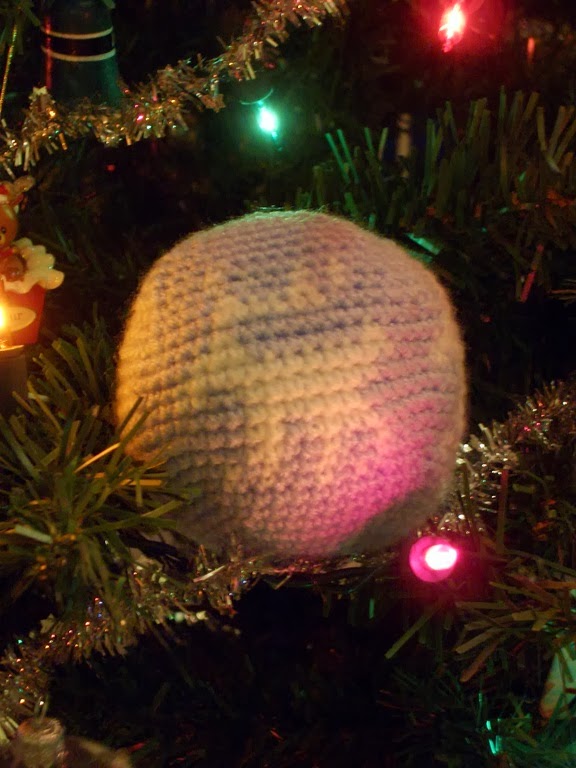
Crochet christmas baubles

I heard that switching colours in crochet work in order to make a picture is called "tapestry crochet".  I've only ever tried this with knitting (where it's known as "intarsia").  I thought it would be fun to make a Christmas Bauble with tapestry crochet.

Because it's in-the-round, the stitches are offset from the ones below and I had to make up some special crochet graph paper to draw the design.  I've gone for reindeer, and I'm telling you that because I'm less-than-pleased with the result and I think you'll need telling what I was aiming for (whoops).


Firstly, I tried to align my increases and decreases to give me more space for the design.  While this works with knitting (because knitting is stretchy), it doesn't work for crochet (because it's firmer) and the result is a slightly wonky and lumpy ball.

Secondly, my choice of pale blue and white was poor because there is not enough contrast to see single stitches in the design, which is why the reindeer looks like it has only three legs.

Gah.  It's now too close to Christmas to fix this pattern ready for release, so I've got another 340 days to perfect this one...