Showing posts with label pattern. Show all posts

Saturday, 14 April 2018

Postcards from Sweden: crochet version

I am so excited to show you my latest creation!


YAAAAAAAY!!!  When I saw the Postcards from Sweden quilt pattern from Jeliquilts here, it was love at first sight.  However, I couldn't afford to quilt it, because this would tie me in to making 2 quilts plus a crochet blanket.  You see, one boy has a crochet blanket so the other was clearly owed one.  I didn't dare add quilting debts to this.  So I had to make the Postcards from Sweden as a crochet blanket for the smallest boy.


Because I cannot step away from the day job, I matched the yarn colours to the original Kona fabrics by writing a python script.  What else would you do?!

The very lovely Kelly has kindly agreed that I can share my colour list with you so you can recreate her work in yarn too!  You'll need to head on over here to download her free pattern, but really you only need to print pages 6 and 7 which describe her layout.  From there, you can write in the yarn colours in to her handy chart and then it's a crochet-by-numbers exercise, and a very lovely one it is too.

Here's the yarn colours I used, numbered to match the original quilt scheme:

  1. Tomato
  2. Matador
  3. Lulk *
  4. Pomegranate
  5. Sage
  6. Green
  7. Pistachio
  8. Leuven *
  9. Citron
  10. Apricot
  11. Saffron
  12. Spice
  13. Pistachio
  14. Kelly Green
  15. Aspen
  16. Cloud Blue
  17. Denim
  18. Turquoise
  19. Empire
  20. Lapis
  21. Sherbet
  22. Wisteria
  23. Magenta
  24. Amstelveen *
  25. Amstelveen *
  26. Lavender
  27. Lipstick
  28. Amersfoort *
  29. Lulk *
  30. Clematis
  31. Fondant
  32. Fondant
  33. Knokke *
  34. Spice
  35. Sunshine
  36. Spring Green

All colours are Stylecraft Special DK, except those marked with an asterisk which are Scheepjes Colour Crafter.  That's 31 distinct colours, I used less than 100g of each colour.

The border is made up of three additional Stylecraft colours:

  1. Grey
  2. Graphite
  3. Cream


In terms of the blocks, they're a solid granny square of UK treble crochet worked in two colours at once, which is achieved by reversing the work direction.  I bring you a diagram:


I worked 6 rounds for each block.  The only non-standard bit is where you reverse direction - after 2 ch, slst into the start of the round, then turn the work and slst back over the ch and then get ready to ch 3 to act as your first tr and you're away again.

Don't worry if the diagram is opaque - I made some video tutorials, so hopefully the diagram will be a good reminder once you have watched them.

There are three parts to the videos:

  1. Round 1
  2. Round 2
  3. Round 3

For the border, I used 5 rounds of linen stitch from the Attic24 blog here.  The colour order is Grey, Cream, Graphite, Cream, Grey.  Again, I was just trying to mimic my favourite quilt binding I've seen on the postcards quilt!

I found it important to keep track of all the squares by storing them on stitch markers as I made them to keep them in order.  Scrap yarn through a square corner would do just as well.

It's like a rainbow slug on my floor.
My squares curled, as you can see in the image above.  It was necessary to block them to 5"x5".  The most painless way is a blocking board - slip them over the pegs and shoot steam at them from above with a hot steam iron - it's enough to relax the synthetic fibres. 

There's no need to fork out for a posh blocking board as long as you've got access to an electric drill and some MDF.  I've heard some people suggest 3mm DPNs as good blocking pegs, but you can save your pennies - 3mm stainless steel rod is widely used in remote control hobby aircraft, so grab yourself some cheap on eBay.  I bought mine too long and owe thanks to my Dad who chopped them up with his grinder.  Sorry Dad.  Then just drill yourself some holes and pop the pegs in.


The blocks are whip-stitched together (I didn't want a visible seam - I wanted to match the quilt look as close as I could).


My little boy now has his own blanket which will doubtless get trashed in den building (as it should be, of course).  If you have kids and are not sure if the blanket is needed - it always is.  Did I mention they look as good as new after a machine wash and tumble dry?!

In my gauge the blocks are 5" square and the blanket comes out approximately double bed sided.  For scale, a real human on the blanket:


Once again, huge thanks to Jeliquilts for offering her quilt pattern to us all for free.  I can honestly say I enjoyed every single stitch I made to re-create her work in yarn.

You might be interested to know that I have started a crochet blanket for me now.  There's no pulling the wool over the kid's eyes (no matter how rainbow coloured) and they've spotted I already made myself a quilt, so have placed their own quilt orders accordingly.  I'd have got away with it if it weren't for those pesky kids...

Monday, 16 March 2015

Ottobre 1/2015 "Elvis" shirt

You can tell when I've got a small baby feeding at all hours of the day and night, because my blog posting frequency suddenly goes up!  I've already read the entire internet, so I've resorted to adding my own content... ;-)

I finally caved in and bought myself my first issue of Ottobre magazine as a treat, a few days before baby Button II arrived.  I was so excited to unwrap it on the postnatal ward (although obvs not as excited as having baby himself).  So many lovely designs to make for the boys!

The main reason to select this issue was the shirt (design 20):

Shirt from Ottobre 1/2015, page preview pilfered from their site.

The sizes start at toddler and go up to about age 12, as I recall, so I am hoping this pattern will see me through the next 10 years at least!  Shirts are what I really like to make for Toddler Button, although I like the cool trousers in the image too, so he might be getting a pair of those.  I just wanted to spare myself drafting shirt patterns constantly and focus on sewing them.

Anyway, the shirt has cuffs and a yoke, which I'd always wanted to add to my own patterns.  Sadly, turns out that the yoke is stylistic only, and not double thickness in the original instructions (as it would be on normal menswear), but there is no reason why I could not cut it to be so.  I'm also planning some yoke style changes to mix things up in the future, and maybe a re-draft of the cuff plackets,  These are all speedy and minor drafting changes though, and should be fun.

I was quite nervous to cut into the fabric because I had some real concerns about the piece designs I'd found on the pattern sheets.  Firstly, the left placket looked narrower than I was expecting, especially compared to the tiny schematic of it they print with the instructions.  Secondly, I wasn't sure where to add seam allowances.  They state "The patterns include hem allowances, placket extensions and placket facings.  When cutting out the garment pieces, add seam allowances of approx 1cm ... to each edge of the pattern."  Indeed, the placket patterns had marked seam allowances on them, but the front opening of the shirt didn't have allowances marked, so I wasn't sure if this was included under the placket rule or not.

The shirt front has two cutting lines marked "left" and "right" for the different sides.  The right button placket is supposed to be narrow for style reasons, and the left placket has a more normal width.  In order to have the collar stand fit the neckline correctly, once the plackets are inserted then the front pieces should finish along the line marked "left".  Since I was super confused about how to get this to work, I ended up re-drafting a new pattern for a placket 2 x 44mm in width, adding the 1cm seam allowance at each edge. I cut two new plackets to my re-drafted design, cut both fronts down to the "right" line, then applied my plackets with a 1cm seam allowance.  Both plackets are now identical, loosing a style feature, but at least the shirt has gone together.  Reading back the instructions with hindsight, I can see how the left placket was supposed to work (and yes, you do need to add a seam allowance down the front), but I'm still confused about the right one.  Perhaps all will be clear next time.

You don't get good garment photos on this blog until I get spare time during the day with two hands!

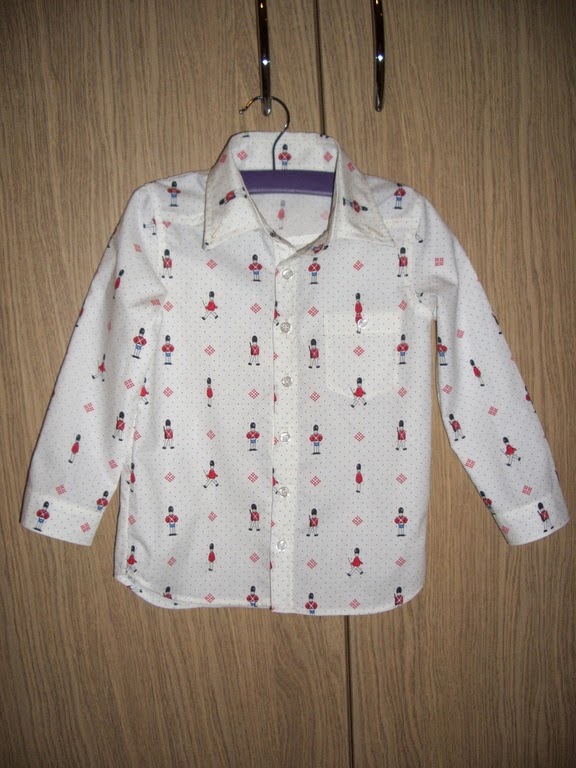
I made the 98cm size in our old friend the Laura Ashley soldier fabric.  It's probably the last shirt I'll get out of it (boo hoo).  I tried super hard to match patterns on this shirt, but there are still a few things I'd do differently with the pattern placement, especially now that I know how the front plackets work.

In other news, the cuff plackets were easier to figure out than I expected (I couldn't find their suggested method in a brief flick through this book so I did a trial run on scrap fabric).  Also, the sleeves went in without fuss, and I overlocked and topstitched the armhole seam after clipping it, so it lay flat.  Not sure why I never thought to clip the seam allowances at the armhole before (clearly I was being dense), so I'll chalk another one up to the learning experience.  I'm still a bit rubbish at getting the hem done neatly and easily around the side curves.  I wanted to do a rolled hem, but there was no way the thick plackets and seam allowances were going to feed through my rolled hem foot so I did a double turned hem instead.

Check out that pattern matching!

I'm really pleased with this pattern overall.  I love the little details like the collar and pocket buttons, and I'm hoping the slim fit will look really smart on.  I can't wait to make more of them!  I massively underestimated the time it takes to sew it with two small children under 3.  I'd quite forgotten how much work goes into a shirt with all the seam grading and top-stitching.  However, the complexity is exactly why I love to make them; a t-shirt just wouldn't be so satisfying.

The shirt is for Toddler Button's little friend.  It's my payment for the amazing Pocoyo birthday cake his kind and talented mother made for Toddler's birthday in December.  I hope it fits him!

In other news, I am really disappointed with the range of shirting and printed dressmaking cottons available online.  I want to make more funky and bold shirts for Toddler, but all the cotton poplin and lawn is turgid floral patterns that even I wouldn't wear.  I'm going to have to resort to quilting cottons (argh) to make cool shirts.  Toddler likes to wear shirts like Daddy, and he'd dress like a crayola box if I let him.  (Favourite outfit: grass-green trousers, blue and purple t-shirt and bright yellow tank-top.  Granny let him wear it once, because she is nice.  Mummy is a big meany.)

Wednesday, 15 October 2014

Free peg bag pattern

I'm feeling in a generous mood.  So generous that I've digitised my peg bag pattern for you, for free.  You're welcome!

Download the pattern here.  (It's a pdf file.)


The pattern pages should be printed on 6 sheets of A4 paper.  (I'm from England, that's how we roll.)  Remember to set "scaling 100%" or "none"  or whatever when you print, as usual when you have print-at-home sewing patterns.  There are red stars everywhere which should align beautifully when you tape it together properly: there are red letters to help you match pages properly.  You should find yourself taping it into a 3 x 2page block which contains three pattern pieces, the largest of which is about 43cm from top to bottom.

Cut around the solid lines.  I have included lightly dotted lines to show the stitching lines: the seam allowance is 1/4" on the outside edges and the opening edges are left raw for you to finish with bias binding.  I recommend 3/4" binding which you can make yourself.

I'm not generous enough to provide instructions, but I'm sure you can work it out.  I will pass on a few options though:

1.  Use just one fabric layer, or a quilted sandwich as I did.  Finish the dart edges and all raw inside edges with bias binding (not just the opening).

2.  Be a bit clever with separate outside and lining pieces, and sew them up such that all the raw edges are hidden in-between the layers after you construct it.  The final construction will be a bit mind-bending, especially around the opening.  I imagine you'll end up turning it inside out through one or both of the opening edges, then binding the opening edges last.  I've not quite thought it through, but it's probably possible to accomplish with minimum hand-sewing somehow.

For more details of how I made my version, clicky here.  I provide handy methods of calculating bias binding here.

You might wonder why I'm bothering to provide a pattern with no instructions.  I can only be bothered to provide patterns for things that aren't obviously easy to draw yourself (with likely first time success).  This pattern has darts in the bottom to create fullness for a multitude of pegs, and the first pattern you might draw for a bag like this doesn't work unless you engage brain.

In case you are interested (probably not), I use a mixture of Inkscape and Scribus to digitise my patterns.  It's both free and powerful!

Thursday, 5 June 2014

New crochet pattern: Fenland Vegetables

The crochet patterns for Fenland Vegetables are now available!  For just £1 you get the patterns for turnip, butternut squash, beetroot, leek, cauliflower, two widths of carrot and parsnip.  In addition, you get both UK and US terms on appropriately sized paper (A4 or US letter).  Is that a deal or is that a deal?


The pattern has been fully tested by some lovely people on Ravelry to whom I owe a debt of gratitude.

Buy it now in my Ravelry Store for just £1!  The pattern is digital and will zoom to you with all the efficiency of the internet.  Woop!

Tuesday, 14 January 2014

Hello Chameleon, hello pattern shopping!


Steady on there!  Hold on to your seats!  You can now get the pattern for "hello chameleon" from my Ravelry store!  Clicky here: buy now

Massive thanks to my patient and committed testers.  This one's not an easy crochet by any means, but I hope it's rewarding.  The tail contains no wire: short rows of crochet are used to create the right curvature for it to naturally form a spiral.  To run the chameleon gauntlet, you'll need to turn the TV off and drink many cups of tea.  Go go go!

The pattern includes both US terms and UK terms, and a 13-page photo tutorial for the first 11 rows, so you're definitely getting your money's worth.

Sunday, 12 January 2014

hello space bunny!

Exciting times!  You can now purchase the pattern for "hello space bunny" from my Ravelry store!  Something to spend your Christmas pennies on...


Buy space bunny pattern now.

Friday, 27 December 2013

Little loopy lamb hat


I found out with a week to go that the children had to dress up for the village nativity play (well, duh).  So I spent a week making loop stitch so that Baby Button could be a little lamb.  Sadly that was as far as the costume went, but he was toddling off around the church so much I'm not sure how much time he spent in the stable with the Holy Family anyway.  The other lamb made it into the pulpit...


I should get this pattern tested soon so that I can sell it and you can all make your lamb hats for Easter.


You know you want to...

Friday, 20 December 2013

Crochet christmas baubles

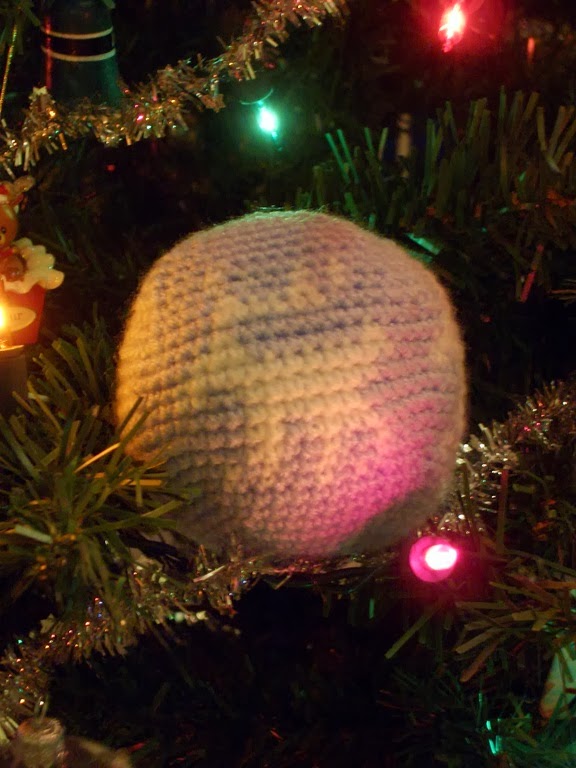
I heard that switching colours in crochet work in order to make a picture is called "tapestry crochet".  I've only ever tried this with knitting (where it's known as "intarsia").  I thought it would be fun to make a Christmas Bauble with tapestry crochet.

Because it's in-the-round, the stitches are offset from the ones below and I had to make up some special crochet graph paper to draw the design.  I've gone for reindeer, and I'm telling you that because I'm less-than-pleased with the result and I think you'll need telling what I was aiming for (whoops).


Firstly, I tried to align my increases and decreases to give me more space for the design.  While this works with knitting (because knitting is stretchy), it doesn't work for crochet (because it's firmer) and the result is a slightly wonky and lumpy ball.

Secondly, my choice of pale blue and white was poor because there is not enough contrast to see single stitches in the design, which is why the reindeer looks like it has only three legs.

Gah.  It's now too close to Christmas to fix this pattern ready for release, so I've got another 340 days to perfect this one...

Wednesday, 18 December 2013

hello space bunny

I finished space bunny!


He was my excuse to use the glittery grey wool I bought at the £1 shop.  In addition, because I wanted a different challenge, he has a transparent PVC visor that I crocheted into.  Good times!


 Bunny is with the good kind pattern testers of Ravelry before his pattern is for sale.


Sunday, 1 December 2013

Tiny Santa Hat

Hello m'dears!

It's advent Sunday, so I've made my first batch of 14 mince-pies, listened to some carols and made a teeny-tiny Santa hat to adorn my secret Santa gift for the WI Christmas dinner tomorrow.  Shhhh - don't tell or they'll know it was me!  (If you are reading from my WI then I'm impressed, and don't give me away on Monday...)


Here's how to make your own, should you wish to make gift-tags or tree decorations from them.  Please contact me if you find an error and I'll be pleased to correct it!  I hope you enjoy it and will consider following my blog.  Please don't sell this pattern or items based on it - it's for your personal enjoyment only.  If you want to sell items made from this pattern then contact me and we can work something out!  :-)

You will need:

DK wool scraps in red and white
3mm crochet hook
tapestry needle for weaving in ends
safety pin (for use as stitch numarker)
scissors

Key to abbreviations:

ch = chain
sc = UK single crochet
dc = UK double crochet
tr = UK treble crochet
dec = decrease by dc two stitches together
[tot] = stitch total at end of round
This pattern is written in UK terms throughout.  To convert to US terms, note that UK tr = US dc, UK dc = US sc, and UK sc = US sl st.

Pattern

1)  In white, make a slip stitch onto your hook.  ch 18.
2)  Join into loop by making a dc into your starting ch.  dc around.  [18]
3)  dc around.  [18]
4)  Switch to red.  dc around in back loops.  [18]
5)  dec, 7 dc, dec, 7 dc.  [16]
6)  3 dc, dec, 6 dc, dec, 3 dc.  [14]
7)  1 dc, dec, 5 dc, dec, 4 dc.  [12]
8)  4 dc, dec, 4 dc, dec.  [10]
9)  1 dc, dec, 3 dc, dec, 2 dc.  [8]
10)  dec, dec.
11)  Switch to white.  dc, then make a popcorn stitch as follows:  into the next stitch, tr 5 times (all into the same stitch).  Remove the hook from the loop currently on it (to leave it hanging "free"), insert your hook under the bar made by the first tr, then pull the "free" loop through.  Finally, make a sc into one of the other stitches at the top of the hat to close it.  Bind off and sew in ends.

Friday, 29 November 2013

Fenland vege-troubles

I finished five vegetables for my friend, who wanted them for an interactive exhibit at the museum where she works.  I already LaTeX-ed up the pattern, so hopefully I shall have it tested at some point soon, when I'm done with the chameleon.  Then I can offer the vegetable patterns for sale as a set.

In other news, I've started work on the next pattern.  A glittery SPACE BUNNY.  Whoa.

Now for the picture explosion:


Cauliflower

Enormous Turnip

Butternut Squash

Beetroot

Leek


Monday, 14 October 2013

Little mitts for chilly digits


Size 12-18 months

These mitts are without a thumb, because who can get a tiny thumb to stay in the thumb bit?  Who can even get mitts to stay on, honestly?  At least these are super quick to make...

Please contact me if you find an error and I'll be pleased to correct it!  I hope you enjoy these mitts and will consider following my blog.  Please don't sell this pattern or items based on it - it's for your personal enjoyment only.  If you want to sell items made from this pattern then contact me and we can work something out!  :-)

You will need:

DK wool (I used Sirdar Snuggly Crofter Baby Fair Isle Effect DK); about 24g = 86yd or 79m.
3mm and 4mm crochet hooks
tapestry needle for weaving in ends
safety pin (for use as stitch marker)
scissors

Key to abbreviations:

ch = chain
sc = UK single crochet
dc = UK double crochet
inc = increase by making two dc into the stitch below
dec = decrease by dc two stitches together
{inst} n times = repeat instructions within {}, n times.
[tot] = stitch total at end of round
This pattern is written in UK terms throughout.  To convert to US terms, note that UK dc = US sc, and UK sc = US sl st.

Mitten Pattern (make 2)

With 4mm hook...

Cuff

1)  Ch 8.  Make 1 dc in 2nd ch from hook, then dc in each ch to end.  Turn.  [7]
2)  Ch 1, dc into back loop of each of the 7 stitches.  Turn.  [7]
... repeat row (2) a further 17 times.
20)  Bring the work into a loop, aligning the 7 starting ch with the row you are about to work.  Ch 1, then dc into each of the 7 stitches, making each stitch through the back loop of the previous dc row AND the bottom of the matching starting ch.  If you catch the starting yarn tail into this row too, then you won't have to sew it in later!

Mitt

From here you will work in the round (continuous spirals).  Use the safety pin to keep track of the starting place.
21)  Turn your work by 90 degrees and continue working around the top of the cuff.  Make 20 dc around the top of the cuff by working into the row ends.  [20]
22)  {3 dc, inc} 5 times.  [25]
23)  1 dc, {inc, 5 dc} 4 times.  [29]
24)  dc around.  [29]
... repeat round (24) a further 12 times
37)  2 dc, dec, {4 dc, dec} 4 times, 1 dc.  [24]
38)  {dec, 2 dc} 6 times.  [18]
39)  {1 dc, dec} 6 times.  [12]
40)  {dec} 6 times.  [6]
41)  Turn mitt inside out and pinch top opening together so that the 6 dc are aligned into 3 pairs.  Make 3 sc through the 3 pairs of stitches to close the hole.  Fasten off.

If you like you can make a ribbon joining the mitts to thread up the sleeves of your child's coat and round their back.  I recommend making sc up the inside of one cuff, then changing to a 3mm hook and making ch stitches until the cord is long enough.  Finally, change back to a 4mm hook to sc down inside the other mitt.

Monday, 1 July 2013

Free pattern: hello stegosaurus

As edited on 20th June 2014:
Fixed row 15 on plate #3, thanks Aparna!


Stegosaurus is worked mostly in double crochet (or, single crochet if you're from the US) and in continuous rounds like a spiral.  To get a uniform look on the stegosaurus body there's lots of stopping, breaking yarn and re-starting.  This is to avoid the different "look" of the stitches caused by changing direction or using a bigger stitch (e.g. trebles).  All these shenanigans mean that you can't pull your work down easily and re-use the wool, so use cheap stuff or count stitches like crazy!  Almost no two rounds are the same, and for that I apologise.  I've been explicit about where to place increases and decreases so that they're evenly spaced psuedo-randomly and they're not too obvious on the finished toy.  It is true that this pattern is complicated, but not needlessly so - if it were worked in the standard continuous spiral manner, the head and tail would appear higher up the body.  The method in this pattern allows the formation of a "hump" along the spine of the toy.

When working on the body, if you break yarn or join on again then you can catch the spare yarn "tail" into every other stitch behind your work as you stitch past the join.  This avoids a tonne of ends to sew in, and possibly makes the toy a bit more robust.

I recommend using a bunch of safety pins as stitch-markers to indicate the beginning of the round, and to mark out any stitches you think you might loose or ignore accidentally when you pass them on the next round.  YOU MUST KEEP TRACK OF THE BEGINNING OF EACH ROUND or your life will be very hard!  The marker should be placed in the first stitch of the round.  On just a few occasions I'll tell you to re-position this start marker further along the round.

Please contact me if you find an error and I'll be pleased to correct it!  I hope you enjoy the toy and will consider following my blog.  Please don't sell this pattern or items based on it - it's for your personal enjoyment only.

***UK CROCHET TERMS THROUGHOUT!***

To change to American crochet terms

Just copy the text on this page into your favourite text editor and do a find & replace to change sc->sl st and dc ->sc (in that order) and colour -> color ;-) and you’re ready to go stateside! Hoorah!

Positioning the start marker

The stitch with the marker in is “stitch 1”, and I always count from the marker. You just move the stitch marker up each round: when you get to the marker, take it out of the stitch it’s in, make that stitch, and place it into the stitch you just made. (The only time you move the marker in a different way is in rows 67 and 79.

After each "round", you will work your last stitch into the stitch right before the marker, or else earlier (if you see the "break yarn" instruction).  You will never blithely continue past the marker in a round - if you find yourself doing this then it's a sign you've made a counting error somewhere.  If you add up the number of stitches involved in each row instruction, you will see they exactly add up to the total (given in square brackets at the end of each row).  I've been very careful to check the mathematical accuracy of this pattern as I wrote it, so you really can rely on the pattern to help you spot your counting errors.

Re-joining the yarn in the next round

Some row instructions are a bit opaque. I'm going to explain the ones where you join the wool in again, using row 19 as an example:

19) Join by making next st in 8th st from start marker (7 st left unworked). 1 sc, 4 dc, +, 1 dc, +, 1 dc, +, 13 dc (... as 3 dc, ^, 9 dc) [33] 

You start counting at the marker (the stitch that the marker is placed in is called "stitch 1", the next stitch is "stitch 2" and so on) and count in the direction you're stitching. In the case of row 19, you count up to the 8th stitch and join the wool in there. So, that's the 8th stitch after the marker. The 1st stitch (with marker in) is left unworked, and so are the next 6 stitches after it, which is what I mean by "7 stitches left unworked". Then you do 1 sc, 4 dc, +, 1 dc, +, 1 dc, +, 13 dc. The sc in this instruction is into the stitch where you just joined the yarn ("stitch 8"). The bit in parenthesis "(... as 3 dc, ^, 9 dc)" explains that the 13 dc are made into 3 dc, then 1 sc, then 9 dc on the row before. You don't need to know that, but it might help to check your stitch numbers are correct! So, adding up stitch numbers on row 19, you should have:

7 unworked & 1 sc & 4 dc & inc & 1 dc & inc & 1 dc & inc & 13 dc = 33 stitches in total, into the 30 stitches on the row before (because we did 3 increases this row).

Extra help

If you are struggling with stitch counting or yarn joining/breaking, I've provided some photo tutorials here.

Keep asking questions in the comments if it's still confusing! :-)  I usually get an e-mail notification and will endeavour to respond to you.  I know this is a difficult and non-standard pattern, and no, short-rows will not produce the same effect (I tried).  However, before commenting please make sure you have read ALL the above text twice and also read through the comments already made on this post as your question may have already been answered.


To shorten the instructions, I'll use the following abbreviations:
sc = UK single crochet
dc = UK double crochet
+ = dc inc (make two dc into one stitch on the row below)
- = dc dec (dc two stitches together)
^ = dc into a sc on the row below.  (I indicate these as a special stitch only to help you keep track of where in the round you are.)
Stitch totals at the end of each row are indicated in square brackets as [total].
Repeated units are inside curly braces, e.g. "{3 dc, +} 3 times" would mean: "3 dc, inc, 3 dc, inc, 3 dc, inc".

To find out how to do a magic ring, see this tutorial: clicky here.

You will need:
Double knitting wool in 2 colours.  I used probably about 50g or less of the main colour.  I wish I had weighed how much exactly...
3mm crochet hook
scissors
tapestry needle for sewing in ends
safety pins as stitch markers
polyester stuffing

Stegosaurus Body


In main colour.

1) Magic ring, 6 dc [6]
2) {+} 6 times [12]
3) {3 dc, +} 3 times [15]
4) 2 dc, +, 2 dc, +, 3 dc, +, 3 dc, +, 1 dc [19]
Pull the magic loop tighter and sew in the loose end.  Nobody wants stuffing oozing out of a dinosaur nose.
5) {5 dc, +} 3 times, 1 dc [22]
6) 5 dc, +, 16 dc [23]
7) 17 dc, +, 5 dc [24]
8) 24 dc [24]
9) 24 dc [24]
10) 24 dc [24]
11) {6 dc, -} 3 times [21]
12) 3 dc, -, 4 dc, -, 3 dc, -, 3 dc, - [17]
13) 6 dc, -, 3 dc, 1 sc.  Break yarn (5 st left unworked in this round) [16]
14) Join by making next st in 2nd st from start marker (1 st left unworked).  1 sc, 1 dc, +, 1 dc, +, 2 dc, +, 7 dc (... as 1 dc, ^, 5 dc) [19]
15) 3 dc (... as 1 dc, ^, 1dc), +, 3 dc, +, 3 dc, +, 1 dc, 1 sc.  Break yarn (5 st left unworked) [22]
16) Join by making next st in 2nd st from start marker (1 st left unworked).  1 sc, 4 dc, +, 4 dc, +, 3 dc, 1 sc.  Break yarn (6 st left unworked in this round) [24]
17) Join by making next st in 5th st from start marker (4 st left unworked).  1 sc, 1 dc, +, {2 dc, +} 3 times, 8 dc (... as 1 dc, ^, ^, 5 dc) [28]
18) 8 dc (... as 1 dc, ^, 2 dc, ^, 3 dc), +, 8 dc, +, 1 sc.  Break yarn (9 st left unworked) [30]
19) Join by making next st in 8th st from start marker (7 st left unworked).  1 sc, 4 dc, +, 1 dc, +, 1 dc, +, 13 dc (... as 3 dc, ^, 9 dc) [33]
20) 12 dc (... as 7 dc, ^, 4 dc), +, 3 dc, +, 3 dc, +, 1 sc.  Break yarn (11 st left unworked) [36]
21) Join by making next st in 10th st from start marker (9 st left unworked).  1 sc, +, 4 dc, +, 4 dc, +, 15 dc (... as 3 dc, ^, 11 dc) [39]
22) 16 dc (... as 9 dc, ^, 6 dc), +, 3 dc, +, 3 dc, +, 1 sc.  Break yarn (13 st left unworked) [42]
23) Join by making next st in 14th st from start marker (13 st left unworked).  1 sc, +, 4 dc, +, 4 dc, +, 17 dc (... as 3 dc, ^, 13 dc) [45]
24) 19 dc (... as 13 dc, ^, 5 dc), +, 2 dc, +, 2 dc, +, 1 sc.  Break yarn (18 st left unworked) [48]
25) Join by making next st in 20th st from start marker (19 st left unworked).  1 sc, {+, 2 dc} 3 times, + (in sc below), 18 dc [52]
26) 26 dc, +, 25 dc [53]
27) 13 dc, +, 5 dc, +, 10 dc, 1 sc.  Break yarn (22 st left unworked) [55]
28) Join by making next st in 27th st from start marker (26 st left unworked).  1 sc, +, 3 dc, +, 5 dc (... as ^, 4 dc), +, 5 dc, +, 11 dc [59]
29) 17 dc, +, 27 dc, +, 13 dc [61]
30) 27 dc, +, 4 dc, +, 4 dc, +, 23 dc [64]
31) 24 dc, +, 18 dc, +, 20 dc [66]
32) 21 dc, +, 26 dc, +, 17 dc [68]
33) 33 dc, +, 6 dc, +, 27 dc [70]
34) 32 dc, +, 37 dc [71]
35) 44 dc, +, 26 dc [72]
36) 54 dc, 1 sc.  Break yarn (17 st left unworked) [72]
37) Join by making next st in 25th st from start marker (24 st left unworked).  1 sc, 14 dc, +, 32 dc (... as 14 dc, ^, 17 dc) [73]
38) 73 dc (... as 24 dc, ^, 48 dc) [73]
39) We have passed the widest part of the body, so begin to decrease.  39 dc, -, 32 dc [72]
40) 30 dc, -, 40 dc [71]
41) 48 dc, -, 21 dc [70]
42) 39 dc, -, 29 dc [69]
43) 34 dc, -, 7 dc, -, 24 dc [67]
44) 31 dc, -, 11 dc, -, 21 dc [65]
45) 27 dc, -, 8 dc, -, 9 dc, -, 15 dc [62]
46) 32 dc, -, 6 dc, -, 20 dc [60]
47) 26 dc, -, 7 dc, -, 7 dc, -, 1 sc.  Break yarn (13 st left unworked) [57]
48) Join by making next st in 26th st from start marker (25 st left unworked).  1 sc, 3 dc, -, 7 dc , -, 17 dc (... as 3 dc, ^, 13 dc) [55]
49) 27 dc (... as 25 dc, ^, 1 dc), -, 6 dc, -, 6 dc, -, 10 dc [52]
50) 23 dc, {-, 5 dc} 3 times, 1 sc.  Break yarn (7 st left unworked) [49]
51) Join by making next st in 22th st from start marker (21 st left unworked).  1 sc, 1 dc, -, 12 dc , -, 10 dc (... as 2 dc, ^, 7 dc) [47]
52) 24 dc (... as 21 dc, ^, 2 dc), -, 6 dc, -, 6 dc, -, 5 dc [44]
53) 20 dc, -, 5 dc, -, 5 dc, -, 7 dc, 1 sc.  Break yarn (0 st left unworked) [41]
54) Join by making next st in 17th st from start marker (16 st left unworked).  1 sc, 6 dc, -, 7 dc , -, 7 dc (... as 6 dc, ^) [39]
55) 23 dc (... as 16 dc, ^, 6 dc), -, 5 dc, -, 7 dc [37]
56) 20 dc, -, 9 dc, -, 1 sc.  Break yarn (3 st left unworked) [35]
57) Join by making next st in 20th st from start marker (19 st left unworked).  1 sc, 1 dc, -, 2 dc , -, 2 dc, -, 4 dc (... as ^, 3 dc) [32]
Stuff the body up to here, and from now on keep stuffing as you go.  The head needs to be stuffed firmly but the body can be softer. 
58) 18 dc, - (into dc and sc below), 10 dc, - [30]
59) 19 dc, -, 6 dc, -, 1 dc [28]
60) 22 dc, -, 4 dc [27]
61) -, 16 dc, -, 7 dc [25]
62) 20 dc, -, 3 dc [24]
63) -, 14 dc, -, 6 dc [22]
64) 17 dc, -, 3 dc [21]
65) 15 dc, -, 4 dc [20]
66) 1 dc, -, 17 dc [19]
67) 19 dc [19]
The start marker has now worked so far around that it's on the dinosaur's back instead of its belly!  We're going to move it forward in the direction of stitching by 8 stitches.  Once you've done that, crochet up to the new position by doing 8 dc.
68) 5 dc, -, 7 dc, 1 sc.  Break yarn (4 st left unworked) [18]
69) Join by making next st in 5th st from start marker (4 st left unworked).  1 sc, 6 dc, -, 5 dc (... as ^, 4 dc) [17]
70) 17 dc (... as 4 dc, ^, 12 dc) [17]
71) 7 dc, -,  8 dc [16]
72) 9 dc, -,  5 dc [15]
73) 15 dc [15]
74) 8 dc, -,  5 dc [14]
75) 14 dc [14]
76) 6 dc, -,  6 dc [13]
77) 9 dc, -,  2 dc [12]
78) 8 dc, -,  2 dc [11]
79) 11 dc [11]
Time to move the start marker one last time.  Move it forward in the direction of stitching by 3 stitches, to what was previously stitch number 4.  Once you've done that, crochet up to the new position by doing 3 dc.
80) 5 dc, -,  4 dc [10]
81) 4 dc, -,  4 dc [9]
82) 6 dc, -,  1 dc [8]
83) 8 dc [8]
84) -, 6 dc [7]
85) 3 dc, -,  2 dc [6]
86) 6 dc [6]
87) {-} 3 times [3]
Sew up the tail end.

Stegosaurus Feet


Make 4 in main colour.

1) Magic ring, 6 dc [6]
2) {+} 6 times [12]
3) {1 dc, +} 6 times [18]
Pull the magic loop tighter and sew in the loose end.
4) 18 dc into back loops of previous row. [18]
5-8) 18 dc [18]
9) 3 sc.  Tie off and break yarn leaving a long tail for sewing together.

Stegosaurus Armour


In accent colour.  The plates are numbered from 1 to 7, starting at the head end.

Plate #3 (make 2)


1) Magic ring, 5 dc [5]
2) +, 1 dc, +, 1 dc, + [8]
3) +, 2 dc, +, 2 dc, +, 1 dc [11]
4) +, 5 dc, +, 4 dc, [13]
Pull the magic loop tighter and sew in the loose end.
5) 1 dc, +, 6 dc, +, 1 dc, +, 2 dc [16]
6) 1 dc, +, 7 dc, +, 6 dc [18]
7) 5 dc, +, 12 dc [19]
8) 1 dc, +, 9 dc, +, 7 dc [21]
9) 21 dc [21]
10) 2 dc, -, 9 dc, -, 6 dc [19]
11) 1 dc, -, 8 dc, -, 6 dc [17]
12) 1 dc, -, 3 dc, -, 2 dc, -, 5 dc [14]
13) -, 5 dc, -, 5 dc [12]
14) -, 4 dc, -, 4 dc [10]
15) -, 3 dc, -, 3 dc [8]
16) 1 sc.  Tie off and break yarn leaving a long tail for sewing together.

Plate #4 (make 2)


1) Magic ring, 5 dc [5]
2) +, 1 dc, +, 1 dc, + [8]
3) +, 2 dc, +, 2 dc, +, 1 dc [11]
4) +, 5 dc, +, 4 dc, [13]
Pull the magic loop tighter and sew in the loose end.
5) +, 6 dc, +, 5 dc, [15]
6) 1 dc, +, 7 dc, +, 5 dc [17]
7) 1 dc, +, 8 dc, +, 6 dc [19]
8) 16 dc, +, 2 dc [20]
9) 1 dc, -, 8 dc, -, 7 dc [18]
10) -, 7 dc, -, 7 dc [16]
11) -, 6 dc, -, 6 dc [14]
12) -, 5 dc, -, 1 dc, -, 2 dc [11]
13) -, 4 dc, -, 2 dc, 1 sc [9]
Tie off and break yarn leaving a long tail for sewing together.

Plate #2, #5 (make 4)


1) Magic ring, 5 dc [5]
2) +, 1 dc, +, 1 dc, + [8]
3) +, 3 dc, +, 3 dc [10]
4) +, 4 dc, +, 4 dc [12]
Pull the magic loop tighter and sew in the loose end.
5) 1 dc, +, 5 dc, +, 4 dc [14]
6) 4 dc, +, 9 dc [15]
7) 15 dc [15]
8) 1 dc, -, 2 dc, -, 2 dc, -, 4 dc [12]
9) 1 dc, -, 4 dc, -, 3 dc [10]
10) -, 3 dc, -, -, 1 sc [7]
Tie off and break yarn leaving a long tail for sewing together.

Plate #1, #6 (make 4)


1) Magic ring, 5 dc [5]
2) 1 dc, +, 1 dc, +, 1 dc [7]
3) 1 dc, +, +, 1 dc, +, 2 dc [10]
4) 1 dc, +, 8 dc [11]
Pull the magic loop tighter and sew in the loose end.
5) 7 dc, +, 3 dc [12]
6) {1 dc, -} 3 times, 3 dc [9]
7) -, 2 dc, -, 3 dc [7]
8) -, 1 dc, -, 1 dc, 1 sc [5]
Tie off and break yarn leaving a long tail for sewing together.

Plate #7 (make 2)


1) Magic ring, 5 dc [5]
2) 1 dc, +, 1 dc, +, 1 dc [7]
3) +, 2 dc, +, 3 dc [9]
Pull the magic loop tighter and sew in the loose end.
4) -, 2 dc, -, 3 dc [7]
5) -, 1 dc, -, 1 dc, 1 sc [5]
Tie off and break yarn leaving a long tail for sewing together.

Tail Spike (make 4)


1) Magic ring, 3 dc [3]
2) 1 dc, +, 1 dc [4]
3) +, 3 dc [5]
4) 4 dc, + [6]
5) 2 dc, +, 3 dc [7]
6) 7 dc [7]
7) 7 dc [7]
8) 2 sc.  Tie off and break yarn leaving a long tail for sewing together.

Flatten the plates and sew them along the spine of the animal in two rows using the picture as a reference.  Sew the four tail spikes into a bunch such that the bottoms of the spikes are left open and they're arranged at the corners of a square.  Sew this bunch on at the end of the tail, by stitching in a square around the base of the bunch.  Stuff the feet and sew them to the base of the stegosaurus; however don't over-stuff the feet or the soles will become concave and make it difficult for the dinosaur to stand up!  Embroider the eyes.


Update 6 July 2013:


I realise now that some bits ARE a bit confusing! So, I added some notes which have since been moved to join the rest of the instructions above.

Update 8 July 2013:


Some errors fixed in pattern for feet.  Thank you chippaliz on Ravelry!

Update 11 July 2013:


Correction to plate 4, row 8.

Update 18 July 2013:


Correction to body pattern row 20.  Thank you Lauren S!

Saturday, 15 June 2013

Free baby pattern: Moonraker Waistcoat


I decided to give this pattern away for free - I hope you enjoy it!

The pattern is for a waistcoat in size 6 months, although it comes up large, probably similar in size to a lot of commercial 9-12 month size baby clothes that my baby wears.  That said, he is actually 6 months old, so the size designation is good for him!  The best way to decide if it will fit your little one is to measure some of their clothes and compare it to the pattern.

Get the pattern pieces here: clicky!
Get the instructions here: clicky again!

I made mine up in some fancy silk for a wedding, but I guess you could make it for casual wear too: it would be cute (and warm) in a pin-corduroy with a cotton back.

You need to print the pattern out on A4 paper at "actual size", or scale 100% (whatever your printer offers you); I've provided you some 5cm square boxes to check the scale.

I'm pleased with the construction method I devised - you won't need to finish any raw edges for this garment as they're all hidden inside the lining.  There's just one edge to hand-stitch shut at the end.  It's all in the instructions.  If you want to save on printer ink, the last page of the instructions is a summary, so you could just print out that page for reference when you've read the rest on screen.

Please don't reproduce this pattern or sell it (or any finished garments based on it).  It's intended just for your personal enjoyment.  If you like it, please consider following my blog - I hope I'll have more patterns for you soon!

To see more pictures of my version, see this previous post.  I'd love to see the waistcoats you make from this pattern: do send me pictures if you like!

Sunday, 9 June 2013

Error! Reverse the stegosaurus!

Mr Button has just pointed out to me that Mr Stegosaurus is not rotationally symmetric about his axis and that's why my crochet attempt looks like a fried egg with a head.

I've been expecting my stitches to travel 22cm over the dinosaur's back, but just 15cm under his belly.  Spot the error?  Only 15 rounds difference!  Whoops!

Back to the drawing board...

Friday, 7 June 2013

Inventing crochet patterns?

Since my last post, I've managed to cut out the waistcoat fabric and sew a few short seams.  Nothing to write home about, since if I had an uninterrupted 30 minutes I could have the thing done by now!  Gah.  Never mind.

In other news, I've been wondering how people invent crochet patterns.  Is it just hook-and-guess?  I'm trying option b) work it out with a pencil.  I've drawn my stegosaurus in profile:

(don't be rude!)


I've counted my gauge with a 3mm hook and DK cheapo wool to be 2.2 rounds/cm and 2 stitches/cm in circumference.  Now I'm going to divide my Mr Stego's body into rounds by drawing lines every 0.45cm (=1 / 2.2) and calculate the number of stitches in each one by measuring off my drawing.  Then I'll set to with my hook and bravely try and accomplish this with a bit of trial-and-error to improve things.  It'll be fun to see how it turns out and I'll be writing my stitch pattern down as I go along.

Now I've published my drawing and idea on the interwebs, the final result will be a brutal display of crochet failure, I predict!  ;-)  Wish me luck!  If it works, you get a free stegosaurus pattern.  If it doesn't you get a laugh and I get a woolly duster.

Friday, 15 March 2013

Chicken pattern weights


These little chickens measure approx. 10cm from beak to tail.  They'd make good pattern weights if you stuff them with something heavy!  You could give them to children as toys if you use safety eyes and soft polyester stuffing.

You will need:
  • Fabric that doesn't fray (I used felt) in red, yellow and at least one other colour for the body
  • Two 10mm wobbly eyes
  • Glue suitable for fabric
  • Red thread, plus other thread to match the body fabric
  • Stuffing: to make the bird heavy you could either use rice or a combination of poly-fil and a large pebble
Download the pattern here.

Cut the pieces as directed in the pattern.  The wattle and comb in red, the beak in yellow and the body and base in any other colour.  The pattern includes seam allowance.

Use red thread to stitch the wattles to the body pieces by sewing a circle around where the eyes will go.  Position the wattles as shown in the photograph.

Glue the two beak pieces together (this makes it stiffer).  Pin the beak and comb in place sandwiched between the body pieces (wrong sides together).

Sew the body pieces together along the back of the bird between A and B, moving the wattles out of the way as you go (so you don't sew through them accidentally).  Make the seam just a few mm from the edge.

Pin the base to the bird, matching A and B.  Start at the rear and sew most of the way around before stuffing the bird and closing it up.

Trim the edge of the fabric to neaten it to a uniform distance from the stitching all the way around.  Glue the eyes on.